Daily Habits That Stick: 15-Min Routine Setup Guide

Daily Habits That Actually Stick: a simple system for consistent routines
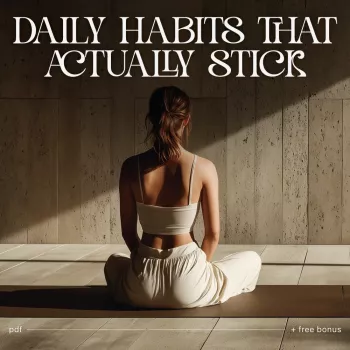
Motivation comes and goes, but a repeatable routine can carry your day. Our “Daily Habits That Actually Stick” digital download is built for real life: small actions, clear prompts, and a checklist that turns good intentions into a plan you can follow—even on busy weeks. Instead of pushing intensity, our team focuses on consistency, so progress keeps happening one doable habit at a time.
If you’ve ever started strong and faded by day six, you’re not alone. Habits tend to stick when they’re easy to start, obvious in the moment, and simple to repeat. That’s the same direction you’ll find in behavior research like the BJ Fogg Behavior Model (behavior happens when motivation, ability, and a prompt meet). Our guide helps you improve “ability” (make it easier) and “prompt” (make it clearer), so you’re not relying on motivation to do all the work.
What makes a habit stick (and why most routines fade)
A habit is easier to repeat when it’s specific. “10 minutes of planning after coffee” gives your brain a clear start line; “be more productive” does not. The more steps and decisions a habit requires, the more likely it gets skipped—especially when energy is low.
Our team built this download around minimum versions, anchors, and lightweight tracking. That means you can keep momentum without turning habit-building into a second job. If you want a quick definition refresher, the APA Dictionary of Psychology describes habits as learned patterns that become automatic through repetition—your job is to make repetition easy.
Sticky Habit Formula (quick reference)
| Piece | What it does | Example |
|---|---|---|
| Cue | Signals it’s time to act | After brushing teeth |
| Tiny action | Makes starting easy | Write 1 sentence in a journal |
| Environment support | Removes friction | Notebook left on the counter |
| Reward/closure | Makes completion satisfying | Checkmark + “done” statement |
What’s included in the digital download (and how it helps day-to-day)
Our digital download is designed to help you turn “I should…” into “I do…” with a structure that’s flexible enough to survive deadlines, travel, family needs, and low-energy seasons.
- A guided framework that breaks habit-building into small steps: choose, simplify, schedule, and repeat.
- An eBook-style walkthrough that turns vague goals into daily actions with clear triggers and time boundaries.
- A checklist format built for fast daily tracking—so you build momentum without overthinking.
- Prompts to identify common blockers (time, energy, forgetfulness, unrealistic expectations) and adjust without quitting.
- A routine-building approach that supports productivity and self-improvement without requiring a full lifestyle overhaul.
If you’re ready to start with a system you can actually maintain, you can grab our in-stock download here: Daily Habits That Actually Stick: Digital Download Guide, eBook & Checklist.
How to use the guide in 15 minutes: set up a routine that survives real life
You don’t need a perfect schedule—you need a repeatable one. Here’s a fast setup you can do once, then refine as you go:
- Pick one outcome for the next 7 days (example: “start mornings calmer” or “end workdays with a plan”).
- Choose 1–3 habits maximum to begin; starting smaller beats restarting later.
- Write the minimum version of each habit (2–5 minutes).
- Attach each habit to an existing anchor (wake-up, after lunch, after closing the laptop, after dinner).
- Decide the exact when/where so the habit has a home: “At the kitchen table after coffee.”
- Use the checklist daily; aim for “most days,” not perfection.
- At week’s end, keep what worked, shrink what didn’t, then add only one new habit if you want.
7-day starter routine (sample you can copy)
| Time/Anchor | Habit (minimum version) | Why it works |
|---|---|---|
| After morning coffee | Write top 3 priorities (2 minutes) | Creates clarity before distractions begin |
| After lunch | 10-minute reset: tidy + water | Midday energy and environment boost |
| After closing laptop/work | Plan tomorrow’s first step (3 minutes) | Reduces next-day friction and procrastination |
| Before bed | Check off today + set out 1 item for tomorrow | Closure and an easy win for the morning |
Build routines that fit your energy: morning, midday, and evening habit stacks
Habits fail when they ignore real energy patterns. Our team recommends building “stacks” that match the moment:
- Calvin Klein Casual Sneakers with Sleek Design and Comfortable Fit
- Calvin Klein Women’s Leather Sneakers
- Crime London Women’s Black Leather Sneakers
Common habit roadblocks (and the quick fixes that keep progress moving)
If you want an evidence-based overview of why small, realistic changes matter, the NIH’s guidance on changing habits for better health emphasizes planning for obstacles and building changes you can maintain—exactly what your checklist is for.
Download, print, and repeat: a simple workflow for long-term self-improvement
FAQ
How many habits should be started at once?
Start with 1–3 habits max and use minimum versions first. After a full week of “most days” consistency, add only one new habit at a time.
Is this better used digitally or printed?
Digital is great for quick edits and keeping the checklist on your phone or computer. Print works best when you need visibility and a daily cue you can’t ignore—choose the format you’ll actually see every day.
What if a routine falls apart after a few days?
Shrink the habit to a 2–5 minute version, strengthen the cue by anchoring it to a fixed event, and use “never miss twice” to restart immediately. It also helps to create a busy-day fallback routine with one habit that protects your main outcome.











Leave a comment